
Blog

FHFA Now Only 'Significantly Concerned' About GSE Earnings
The Federal HousingrnFinance Agency (FHFA) submitted its 2013 Report to Congress on Thursday. The Report covers the Agency’s regulation ofrnthe Federal Home Loan Banks (FHLBanks) and its activities as both conservatorrnand regulator of the government sponsored enterprises (GSEs) Freddie Mac andrnFannie Mae.</p
Most of the report is a collation of previous releases. Some aspects–such as anrnexplanation of the Strategic Plan for the GSEs, or the changes in the SeniorrnPreferred Stock Purchase Agreements–havernbeen covered repeatedly. Rather thanrnsummarize the lengthy reprise of FHFA and GSE activities across the year we arernsummarizing instead the results of FHFA’s evaluations of the twornGSEs. </p
In 2012 FHFA evaluated thernGSEs’ financial conditions, earnings, liquidity, and efforts taken to mitigaternlosses in its single and multifamily portfolios and assessed their responses torncontinued stress in the mortgages markets and its effect on their risk profile,rnperformance, and condition. FHFA uses three approaches in its evaluation;rnongoing monitoring, targeted examinations, and risk assessments.</p
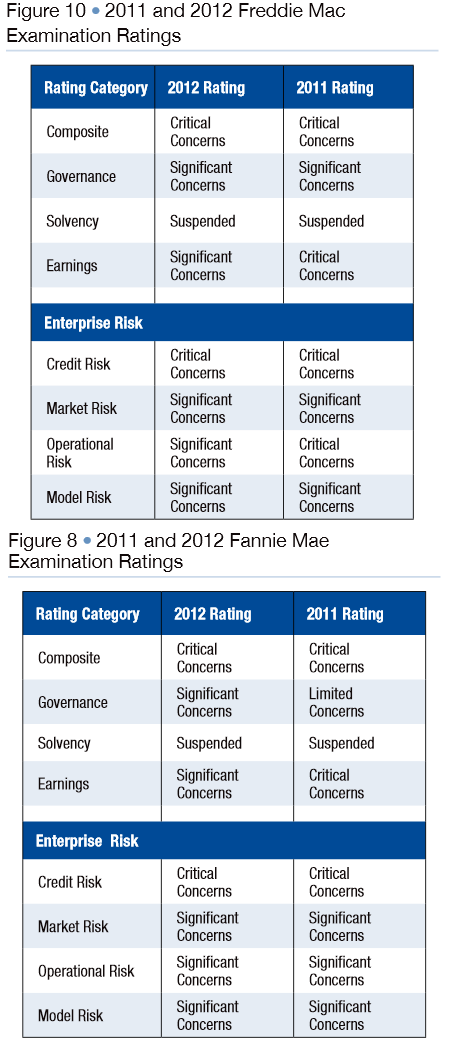
Based on the results of thernevaluation FHFA assigned both Fannie Mae and Freddie Mac a composite rating of criticalrnconcerns, the same as in 2011. Therncritical weaknesses are evidenced by their lack of capital, the quality ofrnlegacy assets, level and extent of internal control break-downs, uncertaintyrnover the sustainability of their recent financial performance, and the naturernof their conservatorship status. Anrnadditional concern specific to Freddie Mac was operational challenges withrnlegacy systems and insufficient business recovery capabilities. Because ofrntheir contractual agreements neither GSE can use its earnings to augment itsrncapital.</p
 </p
</p
Recent improvements in the GSEs financial performance is driven byrnfavorable trends in housing prices, the strong books of business, increasedrnguarantee fees, and actions taken to reduce credit losses and improvernprofitability. The companies continue tornoperate with an excessive amount of credit risk in the single family portfoliornand FHFA continues to have concerns about the condition of key counterpartiesrnand the effect of the accelerated wind-down of the retained portfolio.rn</p
GOVERNANCE:</p
Fannie Mae’s rating for governance was downgraded from 2011 becausernunresolved system issues continue to make Fannie Mae difficult to manage,rnimpede efficiency and raise questions about the reliability and effectiveness ofrnits modeling and forecasting of data.</p
Freddie Mac’s rating of significant concerns was unchanged from 2011. Its board of directors continues to performrnsatisfactorily and a new CEO has strengthened the executive team. Continued uncertainty around the future staternof housing finance poses heightened strategic risk.</p
SOLVENCY</p
The rating for solvency was suspended upon the beginning of thernconservatorship for both GSEs</p
EARNINGS</p
Both GSEs were rated of significant concern for earnings, an upgrade forrnboth.</p
Fannie Mae generated $17 billion in earnings in 2012 and projects 2013 willrnbe profitable but the sustainability of earnings is a concern given nationalrneconomic challenges and possible actions of Congress regarding both the economyrnand the future of the GSEs. There isrnalso concern about the Company’s business lines’ ability to provide arnrisk-adjusted return sufficient to attract outside capital.</p
Freddie Macrnreported net income of $11 billion in 2012 but the primary driver was an $8.6rnbillion decrease in provisions for credit losses. In the last quarter of 2012 it reported arnbenefit for credit losses from reducing loan loss reserves, which is not arnsustainable source of income.</p
CREDIT RISK</p
FHFArnassigned a critical concerns rating to both GSEs in the area of credit risk becausernof the credit characteristics of their legacy books of single-family loans andrnthe potential effect of economic uncertainty, sustainability of performance ofrnthe post 2009 book of business and the credit risk posed by institutionalrncounterparties. Counterparty riskrnremains high and is concentrated in mortgage insurers and mortgage banks. Although the overall direction of credit riskrnhas decreased, delinquent loans and real estate owned continue at highrnlevels. FHFA also mentioned the expectedrnhigher risk of HARP loans in connection with the Freddie Mac evaluation.</p
MARKETrnRISK</p
Arnsignificant concerns rating was assigned Fannie Mae’s market risk, the same asrnin 2011. As the portfolios shrink distressed assets are becoming anrnincreasingly large portion and issues related to liquidity and pricing ofrndistressed mortgages will remain an ongoing challenge. Fannie Mae’s pricing models introduce a highrnlevel of uncertainty into the risk management profile of the portfolio. </p
FreddiernMac’s rating of significant concerns is unchanged from 2011. Although the quality of risk management is adequate</bthe quantity of risk is high relative to earnings and capital. The GSE's retained portfolio continues to berna concern. Freddie Mac has improved thernrisk management framework and took measures to address turnover and humanrncapital risk, however the reliability of risk metrics and human capital riskrncontinue as a concern. </p
OPERATIONALrnRISK</p
Asrnin 2011 Fannie Mae is assigned a significant concerns rating as the quantity ofrnoperational risk is high and will remain elevated through the year due torneconomic uncertainty, changes in information systems, the service environmentrnand remediating compliances deficiencies related to the Sarbanes-OxleyrnAct. </p
Therernis also operational risk attached to the number of FHFA initiatives beingrnimplemented including the securitization platform. Fannie Mae has begun transferring largernservicing assignments to nonbank companies that introduce a new level ofrnrisk. It has a number of effortsrnunderway to address operational shortcomings but these are long term solutions.</p
FreddiernMac’s operational rating of significant concern is an upgrade as the quality ofrnthis risk management is improving but risk levels are high and increasingrnincluding continued dependence on key people, insufficient business recoveryrncapabilities, competing priorities for information technology resources andrnhigh reliance on manual controls.</p
MODELrnRISK</p
FanniernMae was assigned a significant concerns rating. rnVolatile housing and mortgage markets have significantly increased modelrnrisk. Those models used for estimatingrncrucial variables that worked well in the past have failed in the currentrneconomic environment.</p
FreddiernMac’s rating of significant concerns is unchanged. FHFA expressed concerns about modelrndevelopment and the GSE’s ability to set and meet schedules for timely releasernof new and upgraded models. Thesernconcerns arise from a prolonged history of delays of its primary credit modelrnand turnover in key management positions.
All Content Copyright © 2003 – 2009 Brown House Media, Inc. All Rights Reserved.nReproduction in any form without permission of MortgageNewsDaily.com is prohibited.

About the Author
devteam
Steven A Feinberg (@CPAsteve) of Appletree Business Services LLC, is a PASBA member accountant located in Londonderry, New Hampshire.
See all blogsLatest Articles
By John Gittelsohn August 24, 2020, 4:00 AM PDT Some of the largest real estate investors are walking away from Read More...
Late-Stage Delinquencies are SurgingAug 21 2020, 11:59AM Like the report from Black Knight earlier today, the second quarter National Delinquency Survey from the Read More...
Published by the Federal Reserve Bank of San FranciscoIt was recently published by the Federal Reserve Bank of San Francisco, which is about as official as you can Read More...
Comments
Leave a Comment